
Semana Santa Seville 2026 – Holy Week Visitor Guide
Dates, best processions and essential planning tips
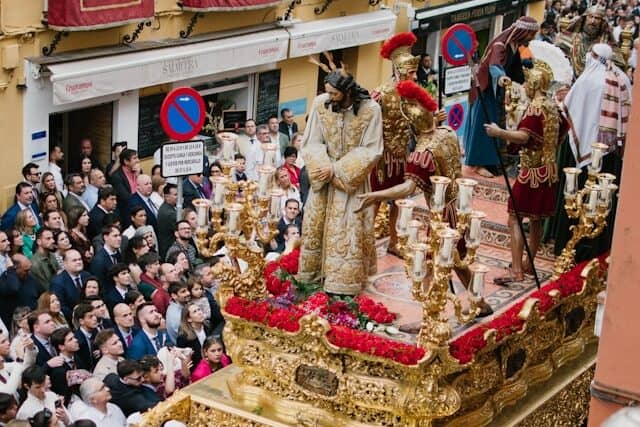
Seville is famous for its elaborate Semana Santa (Holy Week) celebrations, when historic cofradías (brotherhoods) carry beautifully decorated pasos through the streets in solemn processions. It is considered one of the most recognised Holy Week celebrations in Spain and remains one of the most important weeks of the year in Seville.
WHEN IS SEMANA SANTA IN SEVILLE 2026?
Semana Santa in Seville 2026 runs from Sunday 29th March to Sunday 5th April (Palm Sunday to Easter Sunday).
The dates change every year because Easter is determined by the liturgical calendar, so it is always worth checking in advance if you are planning a spring trip.
Processions take place throughout the week, usually in the afternoon and evening. The most intense night is La Madrugá, which begins late on Holy Thursday and continues into Good Friday morning.
WHAT HAPPENS DURING HOLY WEEK (SEMANA SANTA) IN SEVILLE?
Semana Santa, or Holy Week, takes place in the week leading up to Easter Sunday and is one of Seville’s most important religious traditions. While it is celebrated across Spain, Seville is especially known for the scale of its processions and the atmosphere that fills the city.
The week begins on Palm Sunday, when brotherhoods such as La Borriquita commemorate the arrival of Jesus into Jerusalem. From that day onwards, religious brotherhoods known as cofradías or Hermandades leave their home churches and follow a set route through the city before returning hours later.
Each procession represents scenes from the final days of Christ’s life. Some begin in the afternoon, while others continue late into the night.
By Holy Thursday and Good Friday, the focus turns to the Passion and Crucifixion. These are the most intense and crowded days of the week.
One of the most important moments is La Madrugá, which takes place overnight between Holy Thursday and Good Friday. Several of Seville’s most well known brotherhoods process through the city centre from around 01:00AM until late morning. It is widely considered the emotional peak of Semana Santa.
For visitors, it is a powerful and unique way to experience Seville. For locals, it is a deeply rooted religious tradition that is taken very seriously.
HOW SEMANA SANTA PROCESSIONS ARE STRUCTURED
Although each brotherhood has its own traditions, most Semana Santa processions follow a similar order:
The general structure
A procession usually begins with the Cruz de Guía, a large cross that symbolically opens the route.
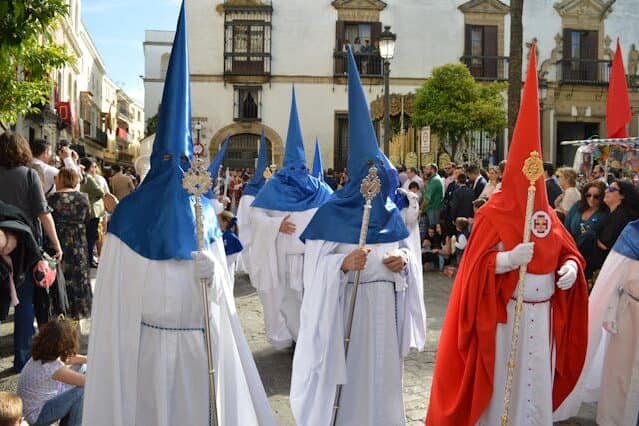
Behind it walk the nazarenos, members of the brotherhood dressed in long robes and pointed hoods called capirotes. They typically walk in pairs, carrying candles or insignia. Their robe colours vary depending on the brotherhood.
Officials and incense bearers often appear between groups, maintaining order as the procession moves forward.
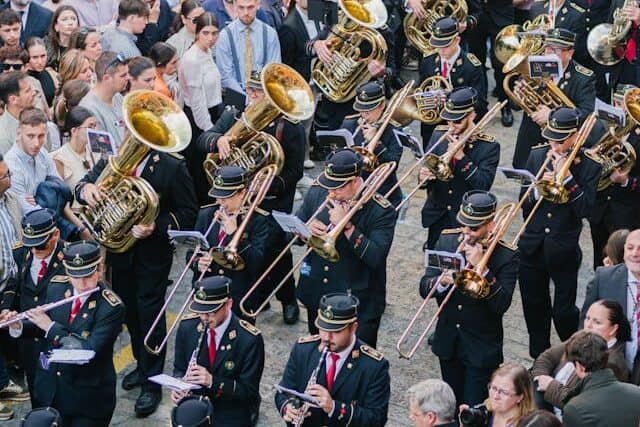
The central element is the paso, the large wooden float that carries the religious image. In most cases, a musical band follows behind, although some brotherhoods process in silence, particularly on Holy Thursday and Good Friday.
What are the pasos?
The pasos are elaborately decorated wooden structures carried through the streets by costaleros, who walk hidden beneath the float.
Not all pasos are identical. While many represent similar moments from the Passion of Jesus Christ, the artistic details differ from one brotherhood to another. The figures have been carved by different sculptors across the centuries, some dating back to the 16th century, and each reflects the style and period in which it was created.
Most brotherhoods carry two main floats:
• One representing Christ, usually depicting a scene from the Passion
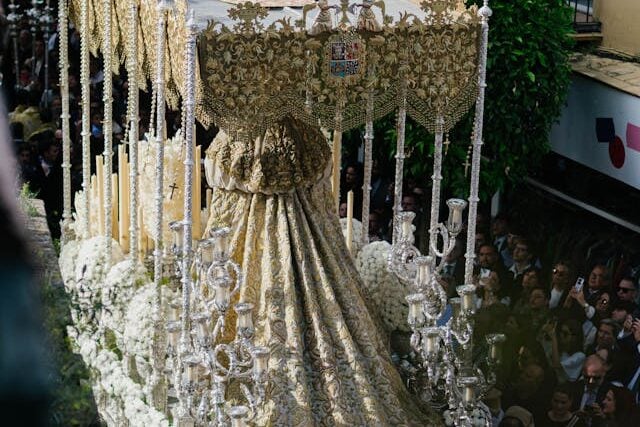
• One dedicated to the Virgin Mary, often beneath an ornate canopy known as a palio
The candles on the Virgin’s float are usually lit after dark, creating a beautiful atmospheric scene in the evening.
The role of the costaleros
The costaleros carry the float from underneath the structure, supporting the weight on the back of the neck and upper shoulders, protected by a folded cloth known as a costal. Guided by the capataz, they move in coordinated steps through narrow streets and around tight corners, giving the paso its characteristic rhythm.
Their movements are carefully aligned with the music played by the accompanying band, so the float appears to advance in time with the melody. This coordination requires months of preparation, and many costaleros rehearse throughout the year in anticipation of Holy Week.
Depending on the size of the float, dozens of costaleros take turns throughout the route.
Who are the nazarenos?
The nazarenos accompany the floats as an act of devotion. Their robes and capirotes vary in colour according to the brotherhood. Some walk barefoot or carry wooden crosses as a form of penance.
Although their appearance may surprise first time visitors and is sometimes misunderstood by those unfamiliar with the tradition, this centuries old practice has deep roots in Spanish Catholic history and forms an essential part of Seville’s religious heritage. Entire families take part, from young children to grandparents, often looking forward to this week all year.
WHAT TIME DO THE SEMANA SANTA PROCESSIONS TAKE PLACE?
Most Semana Santa processions in Seville take place in the afternoon and evening, with the busiest period usually between 18:00 and 01:00. The exception is La Madrugá, which begins in the early hours of Friday (around 01:00) and continues into late morning.
Each brotherhood has its own schedule and route, and timings can vary slightly from year to year. If you are planning to follow a specific procession, we recommend checking the official daily timetable closer to your visit.
BEST PROCESSIONS TO SEE DURING SEMANA SANTA IN SEVILLE
There are dozens of processions throughout the week, and which ones feel most memorable often comes down to personal preference. However, if you are visiting Seville during these dates, we recommend not missing some of the following well-known brotherhoods:
Processions Not to Miss During Holy Week in Seville |
|
| Day | Recommended brotherhoods |
| Palm Sunday (Domingo de Ramos) | La Borriquita, La Hiniesta |
| Holy Monday | San Gonzalo |
| Holy Tuesday | San Esteban, Los Javieres |
| Holy Wednesday | El Baratillo, El Buen Fin |
| Holy Thursday (daytime) | Montesión, La Quinta Angustia |
| La Madrugá (early hours of Good Friday) | La Macarena, El Gran Poder, Esperanza de Triana, Los Gitanos |
| Good Friday (daytime) | El Cachorro |
| Holy Saturday | La Soledad de San Lorenzo |
| Easter Sunday (Domingo de Resurrección) | La Resurrección |
TRADITIONAL FOOD DURING SEMANA SANTA IN SEVILLE
Semana Santa is not only about processions. It is also closely linked to seasonal sweets that appear in bakeries across the city during this week.
Torrijas are the most traditional sweet of Seville Holy Week. They are often compared to French toast as they are made from bread soaked in milk, dipped in egg and fried, and then coated in honey.
Pestiños are small fried pastries flavoured with sesame and anise, and glazed with honey. Their flavour is slightly more aromatic and less soft than torrijas, making them quite different despite both being fried sweets.
Historically, these desserts were linked to Lent, when simple ingredients such as bread, honey and oil were commonly used. Over time, they became part of the cultural identity of Semana Santa in Seville and something you should not miss when visiting the city in spring.
PRACTICAL TIPS FOR VISITORS
Semana Santa is not a typical sightseeing week. The city centre becomes focused on processions, and normal routines change, including transport routes and attraction opening hours.
If you are visiting Seville specifically to experience Holy Week, it can be a very memorable time to be in the city. However, if your priority is relaxed sightseeing without interruptions, we recommend planning your trip for a different time of the year.
That said, visiting during Semana Santa offers a unique atmosphere that you will not experience at any other time. With a bit of organisation and flexibility, it is absolutely possible to combine sightseeing with the Holy Week celebrations and enjoy both sides of the city.
Below are some practical tips to help you make the most of the Holy Week in Seville:
Sightseeing during Holy Week in Seville
During the Holy Week, mornings are the best time for visiting major attractions in Seville. Processions begin later in the day so it’s a lot easier to walk through the streets before midday.
The Seville Cathedral and the Giralda Tower remain open during Holy Week but are usually closed to visitors in the afternoon due to religious services.
Tip – Book Attraction Tickets in Advance
Semana Santa is one of the busiest weeks of the year in Seville, so we recommend booking your main attractions ahead of time.
In particular, secure your
Seville Cathedral and Giralda tickets
and
Royal Alcázar tickets
in advance, as availability is more limited and queues are longer during Holy Week.
If you are staying for a few days, it may also be worth considering the
Seville City Pass, which combines several major attractions into one ticket.
Get a copy of the processional schedule
Before heading out, it is very helpful to have a daily schedule of the processions. Each brotherhood follows a specific route with estimated times for leaving its church, passing key streets and returning home.
You can usually find a printed guide at the tourist office, in local newspapers during the week before Easter or simply asking at the reception of your accommodation. The timetables are very easy to follow, as they list the street names and approximate times.
Plan ahead, but stay flexible
We recommend deciding in advance which processions you would like to see and roughly where you plan to position yourself. However, it is important to remain flexible. Processions are not always exactly on time and streets may close earlier than expected.
Rather than waiting for a procession to arrive at a single spot, it is often better to move through nearby streets and locate it along its route. Processions last many hours, so there is usually an opportunity to find a good place to watch without standing for too long.
If you are uncomfortable in very dense crowds (called bullas in Spanish), avoid narrow streets in the historic centre, particularly during La Madrugá.
Where to stay during Semana Santa in Seville
If you would like to fully experience Semana Santa, we recommend staying in the historic centre. This allows you to walk back to your hotel easily after the evening processions. Areas around the Seville Cathedral, Metropol Parasol (Las Setas) and Santa Cruz place you close to the main routes and the Carrera Oficial, although prices are generally higher during this week.
If you prefer a quieter base and do not mind a short walk, we recommend looking just outside the historic centre. Neighbourhoods such as Nervión, Triana and Los Remedios are typically calmer at night while still offering easy access to the city centre.
Tip – Book Accommodation Early
Accommodation demand during Semana Santa is considerably higher than at most other times of the year. In recent years, Seville has even expanded its hotel capacity due to the high number of visitors during the spring events.
Even so, central hotels often reach full capacity well in advance.
We recommend
booking your hotel in Seville
as early as possible, particularly if you plan to stay in the historic centre.
Dress appropriately
During Holy Week, you may notice that many locals dress more formally than usual, particularly on Palm Sunday and on Holy Thursday and Good Friday. Men typically wear suits, while women choose elegant dresses or smart outfits.
On Palm Sunday, lighter spring colours are more common. By contrast, on Holy Thursday and Good Friday you will see darker tones, especially black, as these days commemorate the Passion and death of Jesus Christ and are traditionally observed in a more solemn way.
On those two days, you may also notice women wearing a traditional black mantilla (a lace veil worn over the head). This is part of the local custom and reflects the religious nature of the week.
Visitors are not expected to dress formally, but dressing respectfully will help you feel more comfortable and avoid feeling out of place. For many people, this remains an important religious celebration.
Even though it is spring, evenings in Seville can still feel cool, so we recommend bringing an extra layer if you plan to stay out late.
You may also be standing for extended periods and walking a considerable amount, so comfortable footwear makes a difference.
Make sure your phone is fully charged before leaving your accommodation, and consider bringing a small power bank, as you may rely on it for checking schedules, maps and updates throughout the evening.
Food, water and facilities
During the busiest days, many central bars focus on quick service rather than full menus. If you have a particular restaurant in mind, we recommend checking opening hours in advance and booking where possible.
If you prefer something simple and reliable without having to wait, bringing a snack and a drink with you can be useful. You will see many locals doing the same.
Public toilets are limited in the historic centre. It is worth planning accordingly before heading out for several hours or choosing a hotel in central Seville so you can return easily during the day.
How to move around and cross a procession
Processions can last many hours, and once a street is blocked, it may not be possible to cross immediately.
If you need to cross, wait until the procession pauses. The costaleros stop periodically to rest, and this is usually when locals move carefully across. It can be initially a bit daunting, but always follow the example of those around you and avoid stepping in front of a float or walking within the procession itself.
When the procession is about to continue, you may hear a signal from a staff striking the ground three times. At that point, make sure you are clear of the route.
Allow extra time to arrive and depart
Road closures and diverted traffic can affect transfers. If possible, plan to arrive and leave Seville in the morning when movement is easier and allow more time than usual to reach the Seville airport or Santa Justa train station.
SEMANA SANTA IN SEVILLE: FREQUENTLY ASKED QUESTIONS
Is Semana Santa suitable for children?
Yes, Holy Week in Seville is suitable for children. Many families attend the earlier processions, particularly on Palm Sunday and in the early evening. However, late-night events such as La Madrugá may be less suitable for young children due to the crowds and long duration.
What happens if it rains during Seville Holy Week (Semana Santa)?
If rain is forecast, some brotherhoods may delay or cancel their procession to protect the floats and religious images. Decisions are often made close to the scheduled departure time. Even if a procession does not go ahead, you can visit the home church to see the pasos inside.
What should I wear during Holy Week in Seville?
Visitors are not expected to dress formally, but respectful and comfortable clothing is advisable, particularly on Holy Thursday and Good Friday. Evenings can feel cool, so we recommend bringing an extra layer if you plan to stay out late.
How crowded does Seville get during Holy Week?
The historic centre becomes very busy, especially in the evenings and during La Madrugá. Streets close several hours before major processions pass. We recommend arriving early and allowing extra time to move between areas.
Are restaurants and shops open during Semana Santa?
Most restaurants, cafés and shops remain open, although opening hours may vary. Restaurants can become particularly busy so we recommend checking in advance if you have somewhere specific in mind.
More on Visit-Seville

Latest Ticket Deals